Accessibility Statement
Accessibility Statement
Last updated: February 2026
Next review: February 2027
Our commitment to accessibility:
DigiBete is committed to ensuring that our website and digital health resources are accessible to as many people as possible, including children, young people, families, and healthcare professionals with disabilities.
We aim to make our content accessible by following best practice and working in line with Web Content Accessibility Guidelines (WCAG) 2.2 Level AA, as required under the UK Public Sector Bodies (Websites and Mobile Applications) Accessibility Regulations 2018.
Accessibility is a core part of our design, development, and content creation process.
Compliance status:
This website and app are mostly compliant with WCAG 2.2 Level AA. Most content meets the accessibility standard; however, there are a small number of known exceptions, which are outlined below.
Non-accessible content:
The content listed below is not fully accessible at present:
- Audio descriptions for some video and multimedia content are still in development. While videos include captions and are designed to be usable with assistive technologies, audio descriptions are not yet available for all content. We recognise the importance of audio descriptions for users who are blind or have low vision and are actively working to address this.
- Certain interactive or dynamic features may present limitations for some assistive technologies.
These issues form part of an ongoing improvement programme and will be addressed as content and platforms are updated.
Where content is not fully accessible, we aim to provide alternative formats on request.
What we are doing to improve accessibility:
Accessibility is considered throughout the design, development, and content creation process for DigiBete. We regularly review our website using automated testing tools, manual accessibility checks, and feedback from users and stakeholders, including healthcare professionals working within the NHS.
Accessibility improvements are prioritised as part of our technical and editorial roadmap.
The DigiBete platform uses ReachDeck technology to enhance the accessibility and readability of our digital content. ReachDeck enables users to engage with our online resources in ways that best suit their individual needs, with features including text-to-speech, reading support, and translation into up to 99 languages.
Helpful guides are available below for anyone who would like more information on using ReachDeck.
The ReachDeck Toolbar Help Guide
Watch this film to learn about ReachDeck and how the toolbar works:
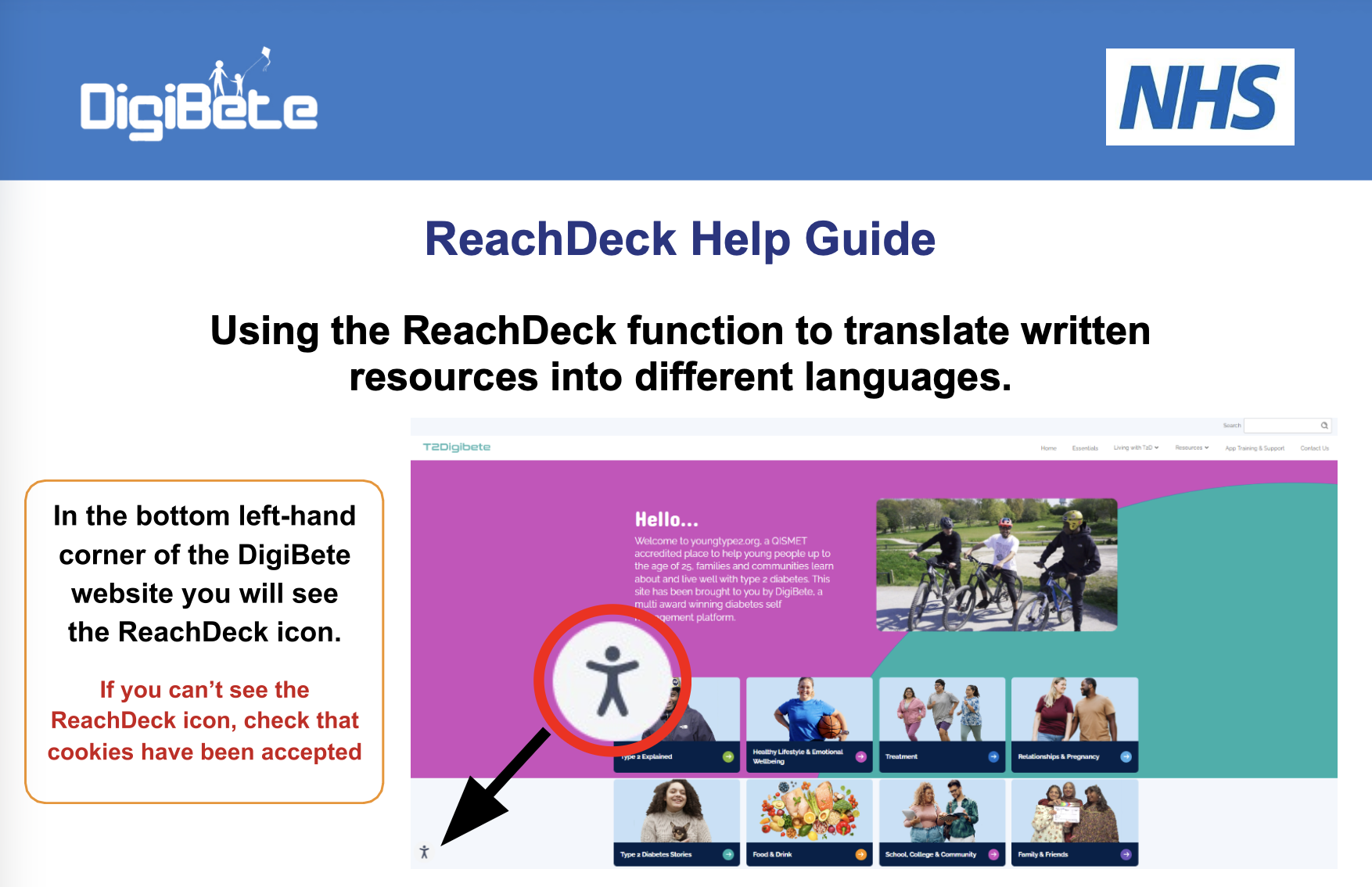
ReachDeck HelpGuide PDF Resource
Here is a helpful PDF resource for using the ReachDeck Tool.
During the build of both the platform and app a detailed analysis of our user demographics was clearly defined, and this process continues to be an integral part of our product development, in partnership work with the National CYP Diabetes Network and through the use of the National Paediatric Data Audit. In addition, ethnographic and co-design research informed the early stages of our work. Ongoing user co-design and real-world evaluation and feedback from across the 172 clinics we serve, inform our work to support users’ evolving needs.
All new features and resources for our app and platform undergo a rigorous co-design and approval cycle (ref. Clinical Risk Management Plan) where new resources and products are tested with users. Research conducted includes user testing, through our DigiBete Champions programme and through in-app surveys, remote testing, popup questionnaires on the clinic portal and PEN testing.
Throughout the evaluation of early versions and pre-release versions, changes were made to the DigiBete app to reflect user feedback and an assessment for usability and accessibility was undertaken. We also have a DigiBete bug fix and change log to support ongoing feedback and are responsive to the feedback on requirements from the Diabetes Team at the NHS Diabetes Programme.
We use a Trello board to prioritise both accessibility and general updates and enhancements from user feedback and this feeds into our development pathway.
The platforms we use for the DigiBete app are Native iOS or Android app and are available to 94% of the population of mobile phone users.
Disability Access:
DigiBete now routinely includes captions on all newly produced video content and is in the process of retrofitting captions to earlier films. British Sign Language (BSL) has been commissioned for all essential films, and these have also been translated into up to 12 additional languages. Transcripts are produced for each essential care film and can be translated into up to 99 languages using ReachDeck software embedded within the platform.
From the outset, the design and development of both the DigiBete platform and app have been informed by a detailed analysis of our user demographics. This remains a core and ongoing element of our product development process. Our work is shaped through close partnership with the National CYP Diabetes Network and the use of data from the National Paediatric Diabetes Audit. In addition, ethnographic research and co-design methodologies informed the early stages of development.
Ongoing co-design, real-world evaluation, and user feedback from across the 172 clinics we support continue to guide our work, ensuring the platform evolves in line with users’ changing needs.
All new features and resources for the DigiBete app and platform undergo a robust co-design, testing, and approval process, as outlined in our Clinical Risk Management Plan. This includes user testing through the DigiBete Champions programme, in-app surveys, remote usability testing, pop-up questionnaires on the clinic portal, and regular penetration (PEN) testing.
Throughout early development and pre-release phases, the DigiBete app was iteratively refined in response to user feedback. Formal assessments of usability and accessibility were also undertaken. We maintain a DigiBete bug-fix and change log to support continuous improvement and actively respond to feedback and requirements from diabetes teams within the NHS Diabetes Programme.
User feedback informs both accessibility-specific and wider platform enhancements, which are prioritised and tracked through a Trello board and fed directly into our development roadmap.
The DigiBete app is available as a native iOS and Android application and is compatible with approximately 94% of mobile devices in the UK.
Access to Smartphones
Based on published data from Statista, smartphone ownership in the UK is as follows:
- 87% of adults aged 16 and over own a smartphone
- 99% of people aged 16–24 own a smartphone
As a result, the DigiBete app is accessible to approximately 95% of patients and families. While a small proportion of users may be operating unsupported operating system versions, the most recent review indicates this affects fewer than 5% of devices in the UK.
Feedback and contact information
If you experience any difficulty accessing content on this website, or if you need information in an alternative format (such as accessible PDF, large print, audio, or easy-read), please contact us:
Email: hello@digibete.org
We aim to respond to accessibility-related enquiries within 14 calendar days.
Enforcement procedure
If you are not satisfied with our response to an accessibility issue, you may escalate your concern in line with the Equality Act 2010 or through relevant organisational or commissioning routes.
You may also contact the Equality and Human Rights Commission (EHRC), which is responsible for enforcing the Public Sector Bodies (Websites and Mobile Applications) Accessibility Regulations.
Preparation of this accessibility statement
This statement was prepared based on internal accessibility reviews and ongoing testing. It will be reviewed and updated regularly to reflect improvements to our content and services.
DigiBete CIC : February 2026